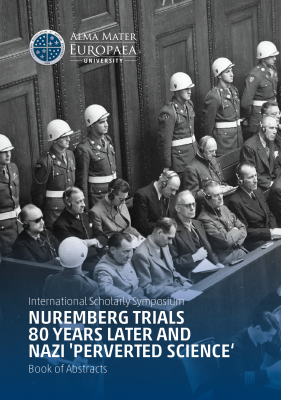
INTERNATIONAL SCHOLARLY SYMPOSIUM NUREMBERG TRIALS 80 YEARS LATER AND NAZI ‘PERVERTED SCIENCE’: Book of Abstracts
Synopsis
The publication International Scholarly Symposium: Nuremberg Trials 80 Years Later and Nazi 'Perverted Science': Book of Abstracts presents a concise summary overview of the key discussions from the international scholarly symposium marking the 80th anniversary of the end of the Nuremberg Trials and addressing the misuse of science in the service of totalitarian ideology. The symposium took place on 27 February 2026 at Alma Mater Europaea University under the umbrella of research, scholarly and publicistic activities of the Programme Group »Research of Cultural Formations« (P6–0278, A, ARIS). The volume brings together contributions from both Slovenian and international scholars, who approach the topic from historical, legal, ethical, and broader civilisational perspectives.
At its core, the publication highlights Nuremberg's significance as a turning point in the development of international law, while also framing it as a moral and ethical warning. Particular attention is given to the phenomenon of so-called "perverted science," that is, the instrumentalisation of scientific disciplines for the legitimisation of violence, the development of racial theories, and the conduct of medical experiments without ethical constraints.
The symposium brought together several distinguished guests, including Prof. Dr Gideon Greif as the keynote speaker, alongside researchers and experts such as Dr Luka Martin Tomažič, Dr Dr Igor Grdina, Dr Alja Brglez, Dr Ferenc Miszlivetz, Dr Mónika Mátay, Boris Hajdinjak, Dr Sebastjan Kristovič, Dr Ludvik Toplak and Dr Daniel Siter, the latter also organised the conference. Their contributions range from legal-philosophical dilemmas (e.g. the Kelsen–Radbruch debate) to historical analyses of Nazi structures and local contexts, as well as reflections on memory, responsibility, and the ethics of science.
The publication thus represents more than a record of a scholarly conference. It offers an important insight into the continuing relevance of the Nuremberg legacy in the contemporary world. In an era marked by renewed political tensions, technological transformations, and ethical challenges, it reopens the fundamental question of the relationship between science, law, and human dignity.
Downloads
References
Downloads
Published
Categories
License

This work is licensed under a Creative Commons Attribution-ShareAlike 4.0 International License.
 English
 Slovenščina